The packaging industry is facing a paradigm shift: away from complex plastic-centric solutions and toward sustainable, recyclable material concepts. With the new European Packaging and Packaging Waste Regulation (PPWR), (EU) 2025/40, the focus is shifting, in particular, to solutions that sensibly complement plastic and optimize material cycles. Fiber-based packaging is one component in ensuring recyclability.
With the DFM (Dry Fiber Molding) machine series, ILLIG packaging solutions GmbH has developed a technology-agnostic addition for applications in which fiber solutions offer ecological and regulatory advantages.
The foundation is a machine architecture that grows with market demands, both mechanically and in terms of control technology. With the ctrlX AUTOMATION platform from Bosch Rexroth, ILLIG has reached a crucial milestone: For the first time, both the motion functions, previously distributed across multiple systems, and the central PLC logic are combined on a single controller. The modular machine concept could be precisely mapped on the software side. The result: significantly less complexity, a noticeably lower engineering effort, and more scope for expansions.
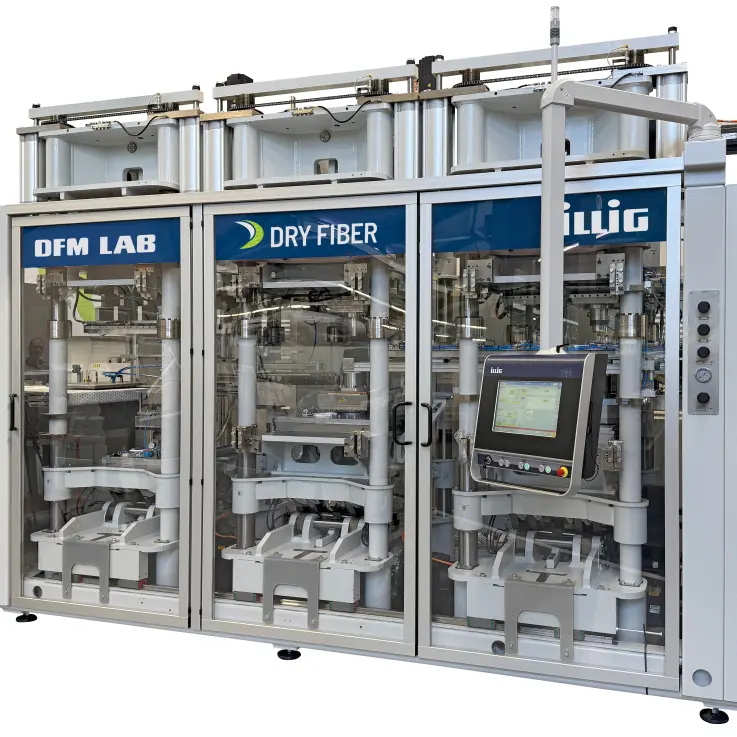
(Image: ILLIG packaging solutions GmbH)

(Image: ILLIG packaging solutions GmbH)
ILLIG is an internationally renowned provider of thermoforming and packaging systems and is further developing the industrial processing of dry natural fiber semi-finished products with the DFM series. The goal is to give customers the option to choose between plastic, fiber, or hybrid solutions depending on the application, thereby optimally meeting regulatory requirements and sustainability goals. For this development, the company has been honored with the German Packaging Award and the Environmental Technology Award of Baden-Württemberg in the Material Efficiency and Resource Conservation category, among others.
With the new machine series, ILLIG faced a dual challenge: On the one hand, existing machines were increasingly reaching their performance limits in highly dynamic applications – especially in the precise synchronization of multiple motion axes and the realization of very short cycle times. This led to a correspondingly performance-oriented control concept: ILLIG machines sometimes used multiple controllers, in some cases even two separate motion controllers, to reliably ensure the required performance.
The control architecture and associated software became very complex. This technical fragmentation increased complexity and made development, service, and maintenance more difficult. A fundamental simplification was necessary.

(Image: ILLIG packaging solutions GmbH)
On the other hand, ILLIG deliberately developed a new machine concept for the new DFM series. The goal was a modular mechatronic architecture where each process station can be integrated into the machine layout via clearly defined interfaces. The main control cabinet is limited to providing power and supplying the powerful servo drives via a common DC bus.
"We wanted an architecture where each process station has its own control cabinet and functions largely autonomously, so it can also be tested autonomously. The main control cabinet should only serve a manageable number of standardized interfaces, making the integration and commissioning of further modules possible with minimal time investment," describes Andreas Moser, Director Engineering at ILLIG packaging solutions GmbH, outlining the vision.
From these two developments arose the central requirement: a control platform powerful enough to unite all PLC and motion functions in one system – and at the same time open enough to consistently map the modular machine architecture on the software side.
For ILLIG, it was clear that this paradigm shift required not only new technology but also a strategic automation partner to realize the vision of a consistently open and scalable platform.
"With ctrlX AUTOMATION, we were able to implement our vision and achieved a major technological leap. We have achieved a significant performance boost. What was previously only possible with multiple controllers now runs on one system, including all motion control functions," explains Moser. With ctrlX AUTOMATION, ILLIG thus took the decisive step: away from a multi-controller concept with complex cross-communication to an integrated solution.
Press drives, handling axes, and other motion functions can now be operated synchronously and consistently in a single controller. This significantly reduces system complexity and simultaneously simplifies engineering, commissioning, and service.
The DFM machine concept is consistently designed for expandability. Process stations are built as clearly defined units with standardized interfaces and can be flexibly added. For example, a second press to increase output can be integrated with significantly less effort – even retroactively if needed. Variants can be realized faster, expansions implemented more easily, and new requirements structurally transferred to the machine.
For ILLIG, this approach pays off directly: The engineering effort for variant configurations has been significantly reduced.
ILLIG also implements the modular approach on the software side. A structured software design is used, which combines the PackML library provided by Bosch Rexroth with an object-oriented approach. This allows the modular machine architecture to be precisely and scalably mapped in the controller, and new machine variants can be created through reconfiguration instead of reprogramming. At the same time, a reusable code base is created, which shortens the training time for new developers and ensures the long-term maintainability of the software.
ILLIG was supported in this by ITQ GmbH, a company from Bosch Rexroth's ctrlX World partner network. The company particularly assisted with the conception and implementation of the software architecture.

(Image: ILLIG packaging solutions GmbH)
ILLIG chose ctrlX AUTOMATION because of its openness. Although the automation platform was new to the ILLIG team, it proved to be quick to learn and very stable in practice, thanks to the comprehensive documentation and the development environment. The open approach makes it easy to integrate third-party components and to flexibly develop the machine architecture further. At the same time, all motion and automation functions relevant to ILLIG are available.
This creates a future-proof foundation: Additional functions can be added on the software side in the future, e.g., database connections, dashboards, or applications for preventive maintenance.
ILLIG is thus also prepared for challenges such as backup, update strategies, and cybersecurity, which are becoming increasingly important. The company is preparing, among other things, to structurally implement the latest regulations – for example, the Cyber Resilience Act (CRA) – in order to be able to react quickly to customer-specific requirements.
In addition to the technology, the collaboration with Bosch Rexroth was also convincing: short reaction times – both in sales and in technical support – as well as a partnership-based exchange on equal footing.
"The decision for Bosch Rexroth and ctrlX AUTOMATION has enabled us to reach a real milestone. Technologically, we are now far ahead and have created a scalable basis for the future," says Andreas Moser.
For ILLIG, the DFM series is much more than a single machine development. It marks the transition to a new machine generation in which mechanical modularity and software-side flexibility consistently interact.
With ctrlX AUTOMATION, ILLIG uses an open, powerful, and scalable automation platform that makes it possible to react more quickly to market demands, implement variants efficiently, and develop machines for the future.
Author: Tobias Gerhard
Position: Senior Business Development Manager Consumer Goods, Central Europe Sales, Bosch Rexroth AG
Phone: +49(711)811-26055
Cell Phone: +49(173)3040558
Are you already connected on LinkedIn?