Industrial image processing—often referred to as “vision”—is on the verge of a paradigm shift. What comes after classical methods, and how does the human eye inspire the automation of the future, from quality inspection to humanoid robots?
Industrial image processing, often called “vision,” is approaching a paradigm shift. Long considered mature, it now faces new production challenges while the relentless advance of artificial intelligence redraws the boundaries of what’s possible. So what comes after classical image processing? And how can physical insight be combined with data-driven methods to build truly robust and flexible solutions for industry?
The journey to modern image processing started with classical, rule-based algorithms. From a physics perspective, it became clear: just as classical mechanics eventually reached its limits and was complemented by quantum mechanics, vision also reached a point where the effort for new solutions was hardly justifiable. Complex tasks like autonomous driving could only be solved in subdisciplines—such as license plate recognition—using the old approaches.
AI was the logical next step, enabling solutions to problems previously deemed unsolvable. But the real revolution lies not in pure AI, but in the fusion of physical first principles and data-driven intelligence. This approach—often called “Physical AI”—ensures that AI doesn’t just recognize patterns but also adheres to physical laws. The system “understands” the world and thus avoids physically implausible hallucinations.
To realize this new generation of vision systems, a single 2D camera is often not enough. The key is capturing the full light field—not just one image from a single perspective, but information from multiple viewpoints and light directions. Instead of taking a single picture, a multi-camera system captures how light behaves throughout the entire scene.
This light-field-based approach from HD Vision Systems delivers decisive advantages:
One of the biggest hurdles in automating quality inspection is human experiential knowledge. An experienced operator often decides at their discretion—and based on years of experience—whether a scratch truly counts as a defect. This domain expertise cannot easily be squeezed into fixed KPIs.
AI fills this gap. Modern systems let quality inspectors transfer their know-how directly to the machine. With simple annotation tools, people “teach” the AI what constitutes a relevant defect. Through a collaborative process between human and machine, a system emerges that not only enables 100% inspections, but also captures and preserves valuable in-house knowledge—an invaluable advantage in times of skilled labor shortages.

Progress is rapid. The combination of advanced capture technology and learning AI is relevant not only for quality inspection or factory robotics. With strong partners like Bosch Rexroth and integration into open automation platforms such as ctrlX AUTOMATION, this technology is gaining reach and finding applications in new domains—from intralogistics to medical technology.
The next major step is seeing, humanoid robots. These systems need eyes that not only emulate human vision but match its robustness and flexibility. The partnership with Bosch Rexroth helps provide the necessary computing power for demanding AI models right at the machine—at the edge. Technologies that already process complex optical information efficiently today are poised to form the foundation of the next generation of automation—from the shop floor to everyday life.
You can find this and other episodes covering a variety of topics on our tech podcast channel, “Industrie neu gedacht,” or on all major platforms.
You can listen to the German episode right here.
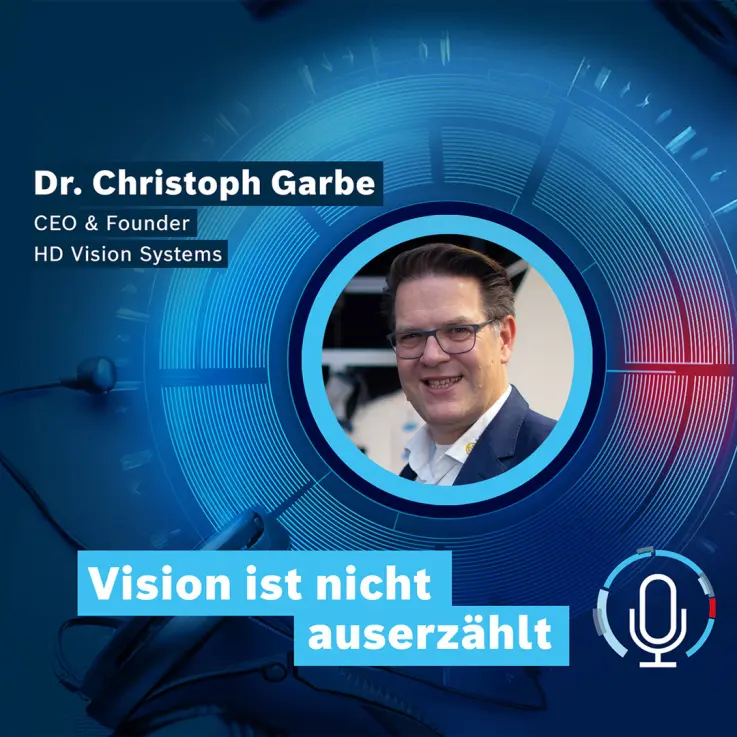
Interview guests:
Dr. Christoph Garbe & Benedikt Karolus
HD Vision Systems
Already connected on LinkedIn?
Dr. Christoph Garbe
Benedikt Karolus
Always stay up to date:
LinkedIn: Bosch Rexroth AG
Tech podcast contact:
Susanne Noll