The world's largest industrial 3D printer is capable of producing sand cast molds for giants weighing up to 60 tons. It was developed and constructed by voxeljet, a specialist in 3D printing systems. The new manufacturing technology of the VX9000 large-format sand binder jetting 3D printer aims, among other things, to reduce production times and costs in the wind and hydropower sector. The precise positioning of the print heads as well as stable and highly accurate motion control presented a particular challenge. voxeljet uses Linear Motion Technology from Bosch Rexroth to solve this issue.
Sand cast molds are particularly suitable for producing large and complex cast parts. These include mechanical parts, components for the wind and hydropower industry, automotive and aircraft parts, as well as works of art and sculptures. A significant advantage is the variety of materials, since different metal alloys can be processed without difficulty.
voxeljet has integrated these strengths into a gigantic 3D printer. The company was selected by GE Vernova to be a partner in the development and commercialization of a large-format printer with sand binder jetting technology. The VX9000 is intended to give new impetus to the US-based foundry industry in the hydro and wind energy sectors.

(image source: voxeljet)
Among other things, sand cast molds are being produced for GE Vernova in the US to cast the main components of the turbines of wind power plants – the aim being to reduce costs in the wind and hydropower sector. In addition, 3D printing is also to be used to test opportunities for lightweight construction measures and functional integration for multi-ton castings. This reduces resource consumption and simplifies assembly work. The joint project between voxeljet, GE, and the Fraunhofer Institute IGCV is supported by the project management organization Projektträger Jülich and the German Federal Ministry for Economic Affairs and Climate Action.

(image source: voxeljet)
The VX9000 3D printer is capable of producing sand molds for castings weighing between 10 and over 60 tons. In large-scale casting, geometries that were previously unthinkable will now be feasible, enabling enormous savings potential in the design and weight of parts for wind turbines. It works with recycled molding sand, just like the sand used in traditional molding processes, thereby enabling economical and reliable additive manufacturing in the foundry environment.
Alexander Kudernatsch, Director Services at voxeljet, explains: "Our VX9000 is currently the largest 3D printer for foundry products worldwide. Never before has a system of this size been designed and built with this construction speed. It goes far beyond the previous areas of application and scale of 3D printers. We brought Bosch Rexroth on board for the implementation. The main criteria for this decision were the long-standing cooperation, the high quality of the Linear Motion Technology products and Bosch Rexroth's comprehensive understanding of the requirements of 3D printing."
"A project of this dimension is special for us as well," says Uwe Schulz, Account Development Manager at Bosch Rexroth. "The project planning phase required the implementation of an 8 m long linear axis with 7 carriages and a precise offset of the print heads. This is the only way to achieve a seamless and high-quality print image. Our highly stable and low-wear Linear Motion Technology components form the foundation for the required accuracy."
The VX9000 utilizes roller rail systems, ball screw assemblies, and the linear modules with ball rail systems and toothed belt drive (MKR) from Bosch Rexroth. These high-performance components are used for the precise height positioning of the axis assemblies. The ball screw assemblies used have already proven themselves at voxeljet in another version – the VX4000 3D printer. The linear modules are used for the precise positioning of the print head. These, too, are already reliably in use in a similar form in other systems at voxeljet.
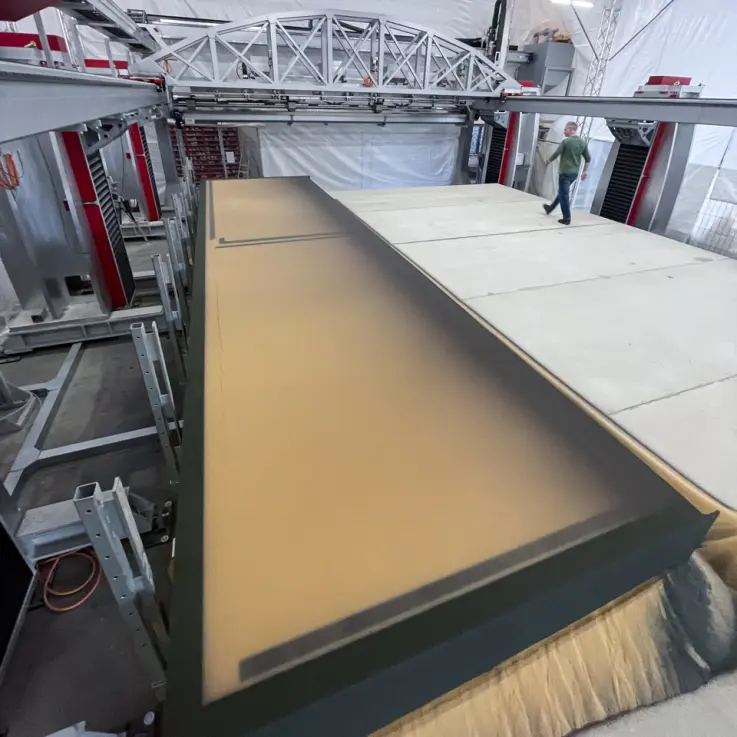
(image source: voxeljet)
"While we are already producing molds for castings weighing several tons with the VX4000, for example for the pump industry, the VX9000 is taking the whole thing to a new level. Bosch Rexroth's profiled rail systems, ball screw assemblies, and linear modules have a unique level of precision and load capacity, which is essential for use in the large-scale production of castings," says Alexander Kudernatsch.

(image source: voxeljet)
The innovative approach of the VX9000, which enables fully additive manufacturing using recycled molding sand, opens up entirely new possibilities for foundry technology. In addition to the cost benefits, this technology also contributes significantly to environmental improvements. The aim is to produce molded parts with reliable casting behavior while ensuring the economical use of standard recyclates in the foundry environment – a decisive step toward more sustainable and resource-saving production.
"Ultimately, it is about paving the way for clean energy production. The project in the USA is a blueprint for various markets that are increasingly relying on sustainable manufacturing technologies," emphasizes Uwe Schulz
Alexander Kudernatsch adds: "The Linear Motion Technology specialists at Bosch Rexroth have a profound understanding of our processes, which has helped us enormously in the further development of the VX9000. This close cooperation enables us to specifically address and drive forward future requirements in terms of speed, precision, and above all sustainability."
Contact Person: Uwe Schulz
Position: Account Development Manager
Phone: +49 7303 9053 907
Cell: +49 174 3173793
Uwe Schulz
Already connected on LinkedIn?
Bosch Rexroth AG