Every hydraulic system needs directional control. Cylinders need to extend and retract. Motors need to start, stop, and reverse. Presses need to close, hold, and release. At the heart of all of it is a directional spool valve—a component that seems simple until you're the one responsible for specifying, sourcing, and installing it.
The Hidden Cost of "Custom"
When a machine builder or maintenance engineer faces a hydraulic control challenge, the instinct is often to solve it with precision: find the exact valve, with the exact spool configuration, for the exact pressure and flow requirements of the application. That's not wrong, but it can lead to a trap.
Custom solutions—whether it's a one-off valve design, a special manifold, or a unique electrical interface—create dependencies. They take time to engineer, they're expensive to source, and when something breaks three years later, good luck finding a replacement. The valve that was "perfect" on paper becomes a liability in the field.
The Case for Standardization
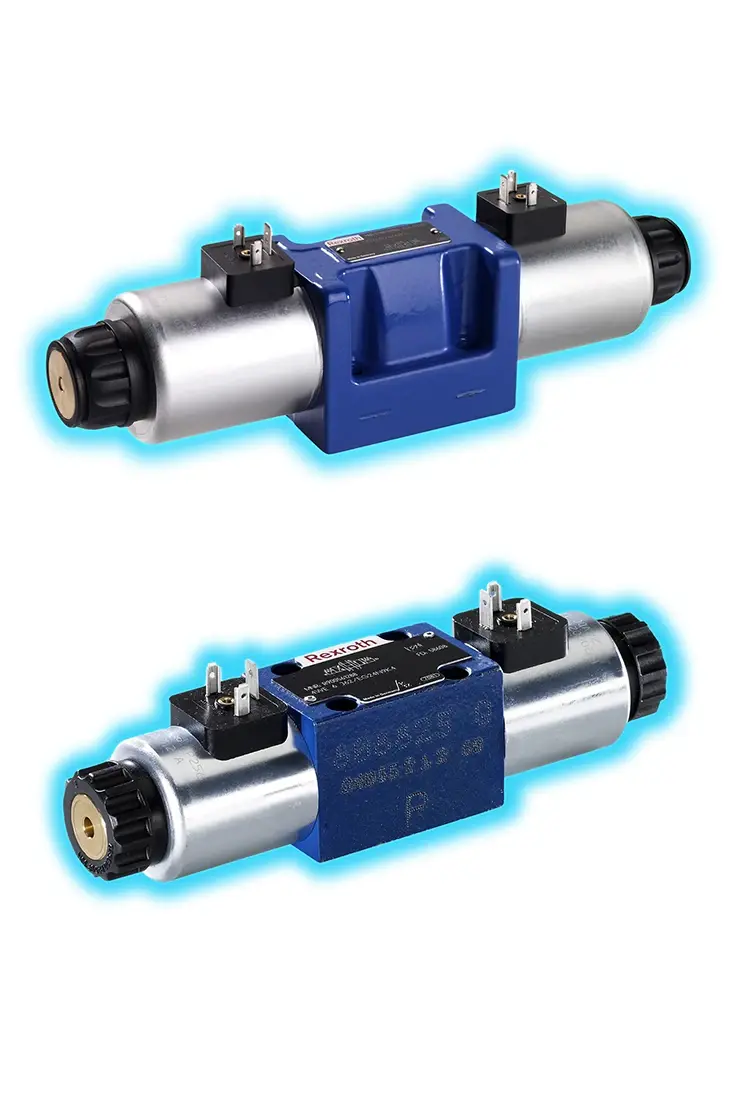
What if, instead of engineering a custom solution, you could choose from a well-designed set of standard options that cover 95% of industrial applications? That's the philosophy behind the Bosch Rexroth WE6 and WE10 directional spool valves.
These are not exotic, application-specific components. They're workhorse valves, designed to handle the most common industrial hydraulic control tasks with proven reliability. And because they conform to ISO 4401 porting patterns, they drop right into existing systems or integrate seamlessly into new designs.
What Makes a Valve "Reliable"?
It's easy to claim a product is reliable. It's harder to prove it. The WE series has decades of field use backing it up. Here's what that experience has taught Bosch Rexroth:
Some operators want simple cable glands. Others need central connectors with status LEDs. Some are building Industry 4.0 systems and need IO-Link communication. The WE series offers all of these options, so the valve fits the system—not the other way around.
The Valve You Can Forget About
The best components are the ones you install and forget about. They work when you turn them on. They keep working through temperature swings, contamination, and millions of cycles. And when you need a replacement five years later, you can order it off the shelf instead of starting a custom engineering project.
That's the WE6 and WE10. It's not the most exciting product in the catalog. It's just the one that works.
Need a directional control solution that won't cause headaches? Contact Bosch Rexroth to learn more about the WE series.