If you're a machine builder or maintenance engineer working with hydraulic systems, you've probably felt the frustration of this choice: do you go with a rugged, high-flow valve that can handle the heavy lifting but lacks fine control? Or do you opt for a precise servo valve that gives you the accuracy you need but might be too sensitive for the harsh realities of the shop floor?
For years, this felt like an unavoidable trade-off. You picked your priority and lived with the consequences.
The Gap in the Middle
The challenge isn't just theoretical. In real-world applications—plastics machinery, die casting, heavy presses—you need both. You need the raw hydraulic muscle to move big loads and handle high pressures. But you also need the precise, repeatable control to ensure quality, reduce cycle times, and integrate with modern automation systems.
Trying to bridge this gap used to mean complex external control systems, separate feedback devices, and a control cabinet that looked like a rat's nest of wiring. It worked, sort of. But it was expensive, time-consuming to set up, and introduced new potential points of failure.
One Valve. Both Strengths
The Bosch Rexroth 4WRLE series was designed specifically to end this compromise. It's a pilot-operated directional control valve with Onboard Electronics (OBE) built directly into the housing. That means the "brain" and the "muscle" are a single, integrated unit.
Here's what that integration delivers:
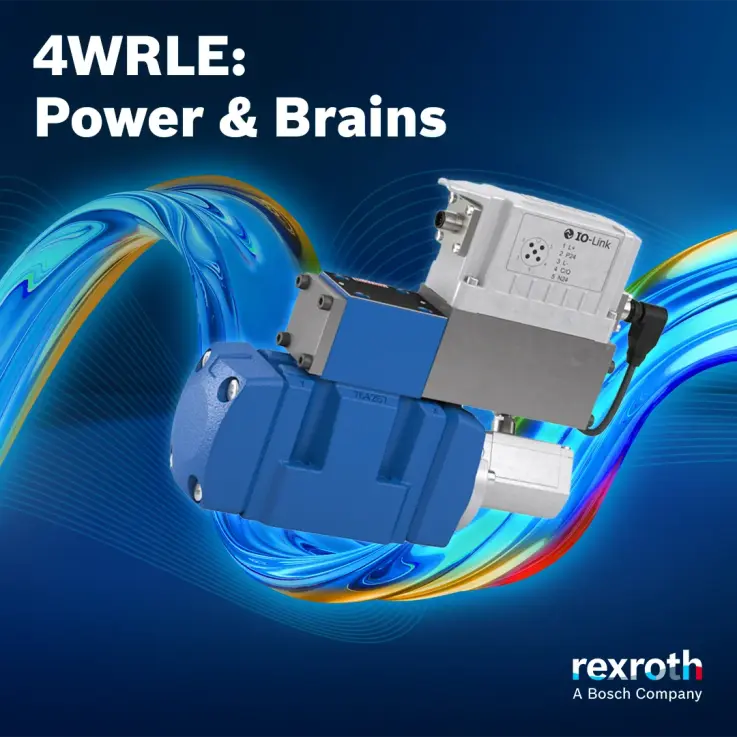
The IO-Link Difference
If you're building machines for Industry 4.0 or just want to make your life easier, the optional IO-Link interface is a game-changer.
Instead of a tangle of analog wires, you get one simple M12 plug. That single connection lets you:
It transforms the valve from a "dumb" component into a smart device that's an active part of your connected factory.
What This Means for You
You stop over-engineering your system. You reduce your component count. You shrink your control cabinet. You speed up commissioning. And you get a machine that's more capable, more reliable, and easier to service.
The 4WRLE doesn't force you to choose between power and precision. It gives you both.
Ready to simplify your next build? Contact a Bosch Rexroth specialist to learn how the 4WRLE can upgrade your hydraulic control.