Thanks to a variable-speed hydraulic power unit from Bosch Rexroth, ZENITH has increased the productivity of the ZENITH 940 HS multilayer block machine by up to 50%, while simultaneously halving the energy consumption.
They are a familiar sight to everyone: concrete blocks in various shapes and colors, used as paving stones and grass paving blocks, masonry blocks and hollow blocks, palisades or curbstones. Less familiar, however, are the sophisticated machines that manufacturer them in long strips with the utmost precision and speed, and stack them in multiple layers to dry. One of the best-known fully automatic, mobile multilayer production machines comes from Neunkirchen near Siegen in North Rhine-Westphalia, Germany: The ZENITH 940 has been continuously refined since the 1960s and has now undergone a fundamental technological overhaul thanks to a comprehensive hydraulics update from Bosch Rexroth.

The ZENITH 940 HS produces a wide variety of concrete blocks ranging from 40 mm to 1,000 mm in height. Various custom designs enable the production of specialty products such as wood-concrete blocks, large-format stacking stones, extra-tall palisades, and shaft rings. (Image: ZENITH Maschinenfabrik)

ZENITH Maschinenfabrik, based in Neunkirchen, is a world-renowned name in the concrete block industry. Its broad portfolio comprises concrete block making machines, fully automatic multilayer machines and single pallet machines, as well as complete, customer-specific circulation systems. (Image: ZENITH Maschinenfabrik)
Founded in 1953 in Neunkirchen, ZENITH Maschinenfabrik GmbH has been part of the QGM Group since 2014 and is one of the main market and technology leaders in the sector. ZENITH attaches particular importance to a wide range of products, short cycle times, and a high level of user friendliness. This also applies to the 940 series, which can manufacturer a wide range of concrete blocks from 40 to 1,000 mm high with reproducible quality. However, when it came to achieving the required increase in productivity, the existing hydraulic design of the machine series reached its technological limits. In order to set ourselves apart from the competition by further improving performance, we had to fundamentally overhaul the multilayer machine and rethink the hydraulic drive concept," explains Senior Vice President and authorized representative Heiko Boes.
The expectations for the new hydraulic approach were high: It needed to make the new ZENITH 940 High Speed (HS) machine generation even more user-friendly, faster, and more energy-efficient – all while maintaining the same geometry, in order to allow continued use of the existing molds of the previous model for customers.
"It was obvious that we needed a change in technology," reports Hartwig Scheld, Head of Hydraulic Design at ZENITH. In search of an innovative drive solution, the development team asked Bosch Rexroth about the potential of variable-speed drives, which have been implemented there for a wide variety of industrial applications for many years.
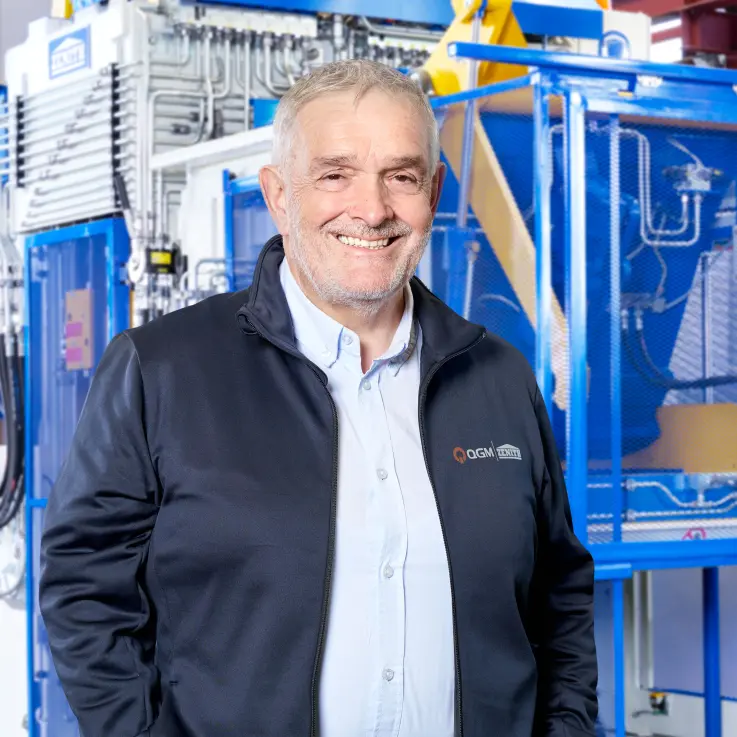
Hartwig Scheld, Head of Hydraulic Design at ZENITH: "The new hydraulics concept from Bosch Rexroth represents a major leap forward for us." (Image: ZENITH Maschinenfabrik)
ZENITH has already benefitted from Bosch Rexroth’s solution expertise in the design of various single pallet machines. For the redevelopment of the multilayer machine, the collaboration has now been extended to the design of the complete drive train – including hydraulic power unit with variable speed drive, control plates, and proportional valve technology. The selected Sytronix unit, consisting of a servo motor and fixed displacement pump, is controlled with high precision by a converter to supply the main movement axes with exactly the required power. In addition to the travel drive, this also includes the cylinders for the vibrating table, mold, load and filling carriage, all developed and manufactured by ZENITH itself.
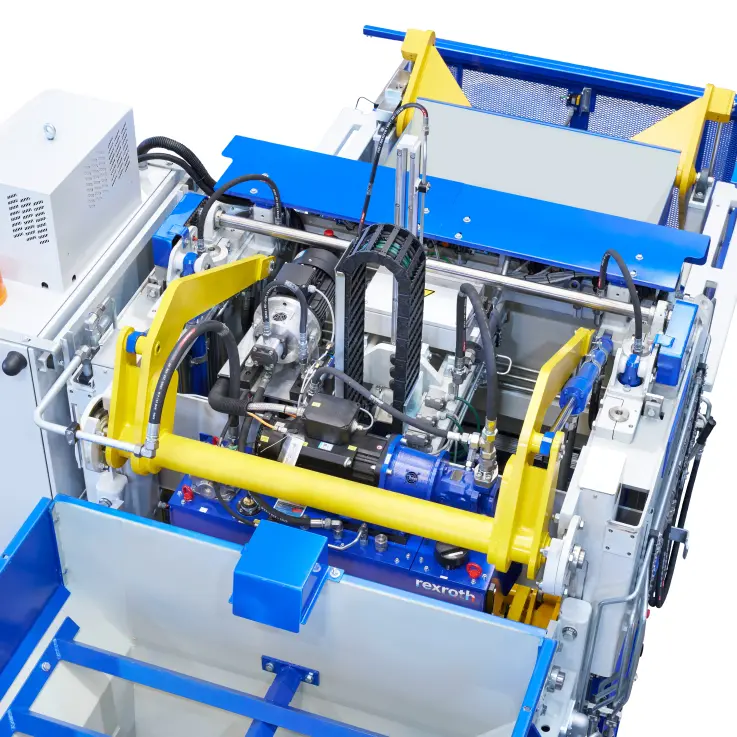
Power on demand: The new hydraulic unit from Bosch Rexroth, featuring variable-speed drive, reduces energy consumption by 50% compared to the previous model while delivering the same performance. (Image: ZENITH Maschinenfabrik)
With the new drive concept, ZENITH is moving away from the previous hydraulic solution on the 940 multilayer machine, which featured two radial piston pumps that continuously generated hydraulic power. Any power that was not needed by consumers was lost as waste heat, which had to be removed from the machine by a cooling unit, requiring additional energy.
The new Sytronix drive delivers power on demand: It provides high volume flows for dynamic motions and high pressures for holding phases exactly when they are needed. As a result, no energy is wasted, there is less waste heat, and noticeably lower noise emissions.
With the new power-on-demand drive, ZENITH was able to replace the two previous pumps, each with a nominal flow rate of 20 l/min, with a more powerful model with 40 l/min, and on which the flow rate can be increased to up to 80 l/min by using higher pump speeds. The converter regulates the speed of the motor-pump unit for each operating point in such a way that the required pressure of up to 250 bar and the required volume flow are provided exactly.
At 10 kW, the base load of the new hydraulic drive is only half that of the predecessor model, the ZENITH 940 Speed & Comfort (S&C). The energy efficiency, which is around twice as high, is particularly important in hot production environments in order to prevent overheating of the fluid with the help of the oil-air cooler. In addition, the new design of the hydraulic power unit simplifies maintenance. The hydraulic pump is now positioned horizontally on top of the oil tank and can be accessed easily for maintenance and repair work.
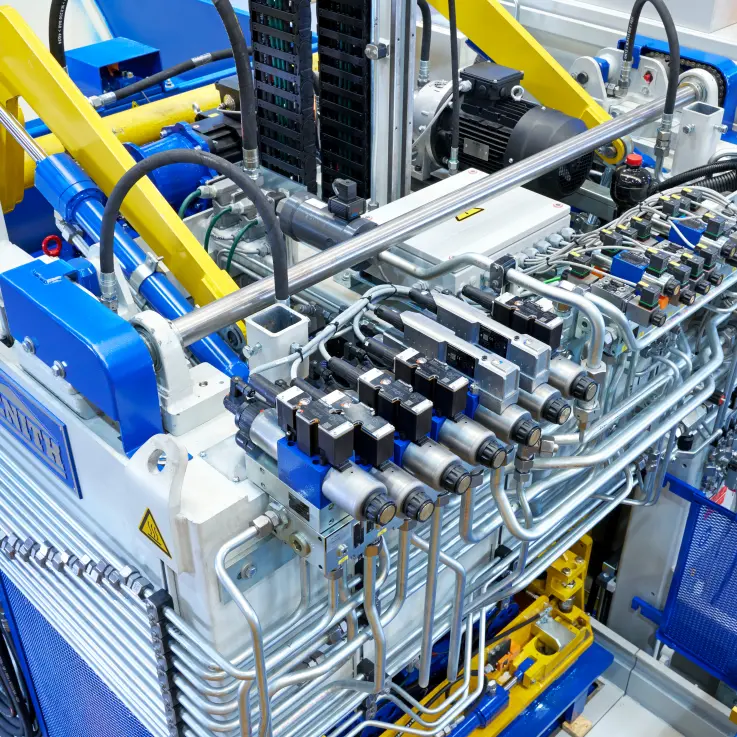
Faster cycles thanks to shorter switching times: The latest generation of proportional valves (type 4WREE) from Bosch Rexroth precisely control the hydraulic cylinders, enabling high dynamic performance. (Image: ZENITH Maschinenfabrik)
According to Scheld, the new generation of proportional valves from Bosch Rexroth also increases competitiveness. "By precisely controlling the flow rates for the cylinders, we are able to achieve extremely short switching times, meaning that the pendulum movements of the filling carriages, in particular, become even faster and more fluid." The Rexroth valves have also proven themselves to be extremely robust in practice against vibrations and the frequent shaking.
Due to the lower heat input and the 3 µm filtration recommended by Bosch Rexroth, the hydraulic oil only needs to be replaced half as often. This not only saves resources, but also reduces the susceptibility to malfunctions, since the filtered concrete dust from the environment cannot jeopardize the operability of the proportional valves.
As a result, ZENITH customers benefit not only from stable processes and reproducible quality, but also from high ease of maintenance – especially since the proportional valves are visualized in a separate screen on the machine's intuitive, menu-controlled touch panel. "Using the current piston position, any failures are immediately visible, making lengthy troubleshooting a thing of the past," says Scheld. "In conjunction with our remote support, we can now analyze around 95% of all errors in the machine instantly to ensure optimum availability."
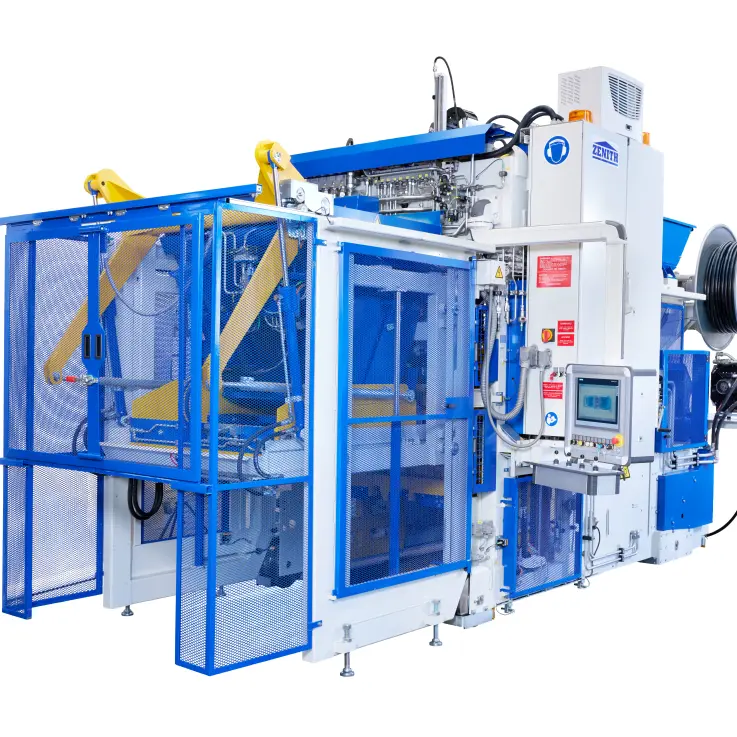
Up to 50% higher output: the fully automatic ZENITH 940 High Speed (HS) mobile multilayer block making machine with variable-speed hydraulic drive and fast proportional valves from Bosch Rexroth. (Image: ZENITH Maschinenfabrik)
The combination of the dynamic Sytronix drive train and responsive proportional valves is the key to success: The output of the multilayer machine has increased by 20 to 50% compared to the previous solution – depending on the material, stone size, and filling of the hoppers, which can also be handled fully automatically via an optional feeder bridge. The recipe is selected via the touch panel. "Our new hydraulics concept enables us to give customers even more possibilities to optimize their processes," explains Scheld. "For example, we have managed to increase repeat accuracy from 30% to 90%, making the reproducibility of products even more efficient."
"The variable speed drive with a flow rate of up to 80 l/min allows the control axes to be positioned precisely by means of a pressure specification," says Scheld. "This means that the load can now be moved at up to three times the speed, which has a positive impact on productivity, especially over longer distances."
The purely electric control of the variable speed drive also simplifies the programming of the machine and enables more intuitive operation. At the same time, the engineering complexity is reduced, as the axes can be controlled digitally via the two control values, set pressure, and speed. The converter takes care of everything else, including feedback.
Furthermore, the simplified hydraulic design streamlines logistics, as fewer components need to be stocked. "With the new valve series, we have been able to reduce the number of types from eight to five," Scheld explains. "In the predecessor series, we built the complete hydraulics including the control block ourselves, whereas now we are using individual components from Bosch Rexroth, enabling us to achieve significantly shorter delivery times."

The new ZENITH 940 HS multilayer machine manufacturing bricks. (Image: ZENITH Maschinenfabrik)
Senior Vice President Boes describes the result of the intensified collaboration with Bosch Rexroth as a real quantum leap. "Together,we have developed a solution for the future – moving away from custom hydraulics toward a standard modular system for powerful and energy-efficient hydraulic drives," says Boes. "We intend to progressively unlock this potential for our other machine platforms and consolidate our leading market position."
Thanks to variable speed drives, multilayer block machines and many other industrial hydraulic applications consume significantly less energy while delivering the same or higher performance. Since the power-on-demand concept provides optimum power for every operating situation, the energy efficiency increases in the double-digit percentage range compared to throttle control. Important productivity factors such as control quality, dynamics, and movement precision are also increased. In addition, less hydraulic fluid is required. The lower CO₂ emissions reduce the ecological footprint. At the same time, the intelligent electro-hydraulic design reduces outlay over the whole life cycle – from development and integration right through to servicing.
Author: Heiner Stueber
Position: Sales for Central Europe in the Industrial Hydraulics Product Division | Western Germany
Phone: +49(2102) 409-225
Mobile: +49(172) 7434962
Are you already connected on LinkedIn?