TASS verification system Houston, everything is fine!

TASS. The new way to validate tightening technology.

To the Rexroth Store

POWER YOUR PROCESSES with the TASS verification system from Bosch Rexroth

The new TASS (Torque Angle Slip Standard) verification system from Bosch Rexroth is a groundbreaking method for verifying safety-critical tightening connections. Thanks to the on-the-fly process, quality can be ensured directly at the workplace. By integrating the verification of the tightening tool into the assembly process, downtime is minimized and possible deviations are identified during ongoing production. Start a new era of joining technology with TASS – the fully automatic verification system from Bosch Rexroth.

Bosch Rexroth offers a new way to validate your tightening technology with the TASS in short cycles and without removing it from the system. TASS stands for Torque and Angle Slip Standard, so the name already indicates that the torque and angle of rotation are tested in a single test run using a dimensional embodiment. The test itself takes only a few seconds, and you will receive immediate feedback on the test result.

The operating principle of TASS

  • In a TASS verification, a torsion shaft is driven with the tightening tool, which represents a specific and consistent dimensional embodiment.
  • During the rotation of this torsion shaft by the tightening tool, two torque values, the angle of rotation between the fixed stops, and the linearity of the torque curve are checked.
  • The values determined during the verification in the manufacturing plant are compared with values from the calibration of the TASS verification system, and immediate feedback on the result of the verification is provided to the plant control system.
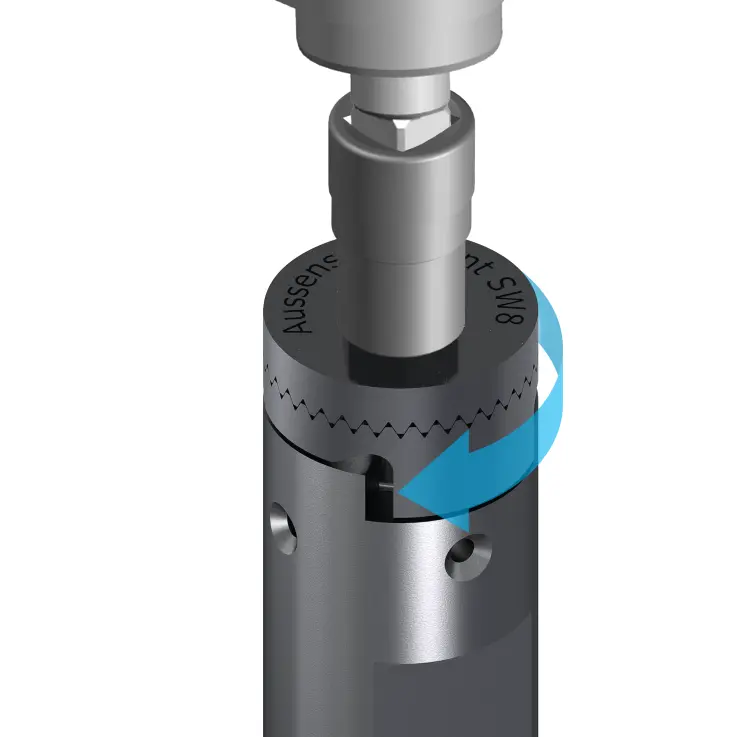
Rendering TASS functional principle

The highlights of the TASS verification system

  • Time and cost savings: no need to remove the spindle, as the process is automatable and error-free; production stops are eliminated
  • Minimization of the risk during sensor readjustment, as spindle removal is no longer necessary
  • Immediate feedback (IO/NIO) through continuous validation

  • Clear countermeasuring: immediate initiation of measures in the NIO case, process can be carried out as often as desired
  • Fast troubleshooting possible through short-cycle counter-measurement of the tightening values (e.g. daily)
  • Reduction of machine capability inspections (MFU): by extending the periods between MFU intervals (usually once a year), costs can be reduced by more than 50%

Our product range for the TASS verification system

TASS Element

TASS Element

  • consisting of housing and torsion shaft inside
  • Hirth splines for connecting interchangeable parts

TASS spare parts

Interchangeable parts

  • Interchangeable parts serve as a coupling to the tightening system.
  • Interchangeable parts with standard threads and connection profiles (external hexagon and hexagon socket, Torx)

TASS Interchangeable Blanks

Interchangeable blanks

  • The interchangeable blanks can be used to produce suitable connection profiles with the correct tightening geometry for the customized application.

TASS software

TASS software

  • The TASS Setup Software is used to determine the system-specific parameter values.
  • With the TASS Setup software, direct access to the tightening curves and parameter data is possible.

Learn more about the TASS verification system

The Physics Behind TASS

1. The TASS element consists of a fixed housing (1)

2. and a movable torsion shaft (2)

3. The torque increase up to point M1(3) results from overcoming the preload in the torsion shaft.

4. After reaching point M1 (corresponding to the preload of the torsion shaft), the torsion shaft is twisted between the two stop surfaces on the TASS element. This range W3 (4) corresponds to a torsion angle of 12° and is characterized by a linear increase in torque.

5. At point M2 (5), the torsion shaft rests on the second stop surface. In the further course, the housing of the TASS element is twisted. The torque curve is significantly steeper.

6. The test is completed at a moment M3 (6) significantly above M2.

7. By evaluating the measurement results at points M1 and M2 as well as a freely definable envelope curve around the command curve, it is verified whether the test is OK.

TASS verification system catalog

Get the complete overview of the TASS verification system here.

Included in the catalog:

  • Detailed information on the TASS verification principle
  • Overview of components and software
  • Order information for TASS elements and accessories
  • Dimensional drawings and technical data

TASS verification system support – resources